Put your coding agents to work, without giving up control.
Nodal supervises Claude Code and Codex across isolated worktrees and human-gated integration. Their work comes back as a branch you review before anything merges.
Give every agent its own territory.
Agents never edit your working tree. Session agents work in Nodal-owned git worktrees, pipeline agents in a staged clone outside the repo, and their work reaches you as a branch and a pull request.
Watch, intervene, and recover.
Transcripts, approvals, run records, staged transfers, and committed work are durable across reconnects, worker restarts, crashes, and project reopens. A crash ends the live agent process, and Nodal tells you exactly what stopped rather than pretending otherwise.
Stop copy-pasting one model's answer into another.
Put Claude Code and Codex in the same room. Nodal runs structured positions, critiques, revisions, and comparison, then shows accepted points, unresolved disagreements, and evidence linked to the exact frozen context each model received.
Multiple models review the work. You make the call.
Refresh the token on every request where expiry < 60s. Simple, and it never serves a stale session.
That fires a refresh per in-flight request. Under concurrency you get a token stampede and the last write wins. Refresh once behind a lock.
Conceded. Single-flight refresh behind a mutex, everyone else awaits the same promise.
From the beta build.
Four surfaces, live · drag to rearrangeWhere to next?
Every session keeps its transcript, its territory, and its model.
[ Runs ]Stage by stage, with the gate that stopped the run named.
[ Session detail ]Tool calls, diffs, and approvals in the order they happened.
[ Cost ]On the subscription you already pay for. Nodal resells nothing.
Nothing permanent happens by implication.
Merging is a human action that no autonomy setting can grant. Context sharing, spend and destructive calls pass through explicit gates, and approval is bound to the exact action and material you reviewed.
Twelve places you actually work.
Sessions
Resume managed work or start from a goal.
Requests
Rule on every gated action from one audit surface.
Runs
Every run, live and past.
Roundtable
Structured cross-model critique with frozen context.
Operator
Delegate an autonomous run with visible limits and controls.
Plan
Plans as objects, on an editable canvas.
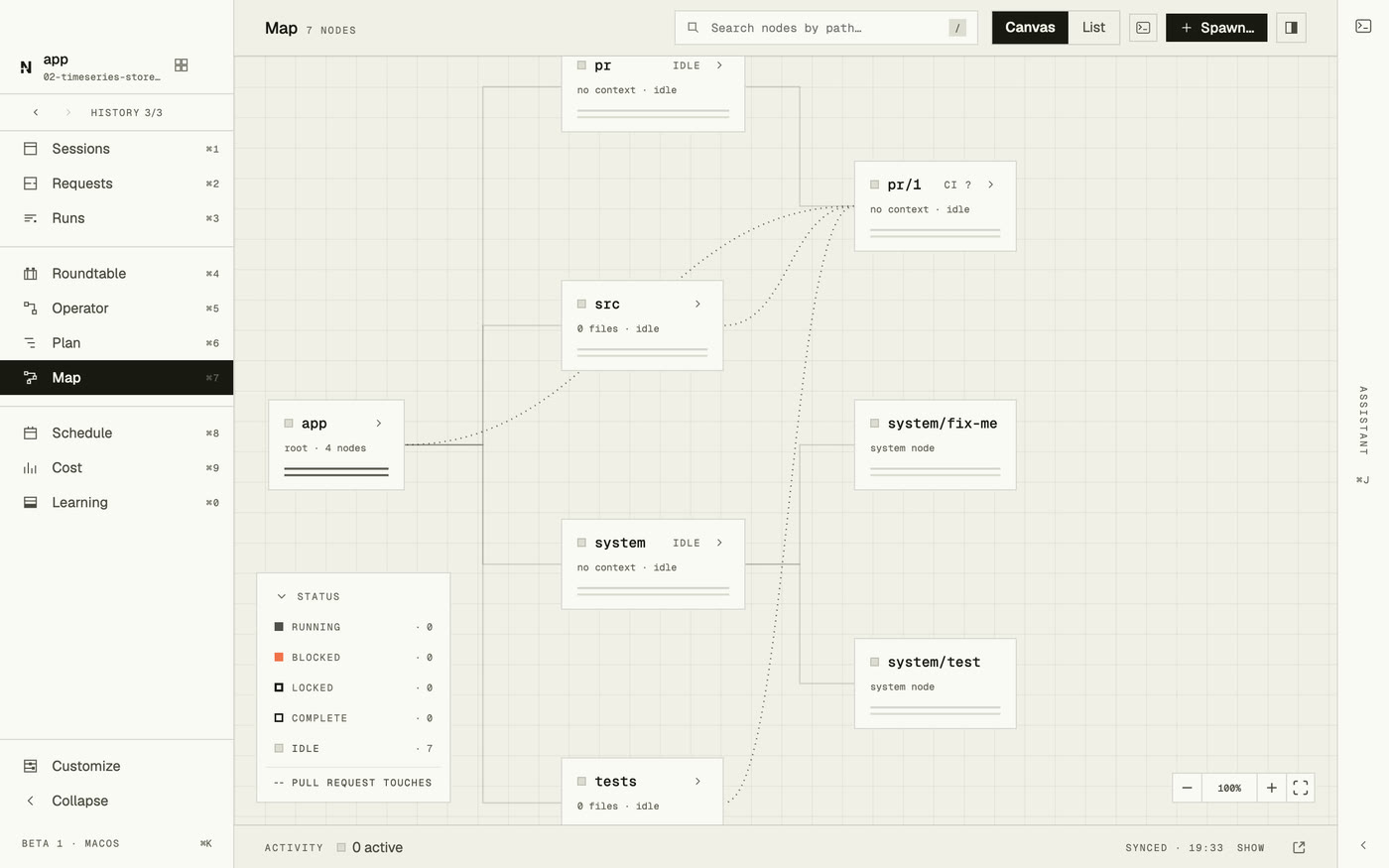
Map
Agents, branches, dependencies, locks, and contention.
Schedule
Recurring runs and the windows they run in.
Cost
Spend per project and per run against a monthly budget.
Learning
What Nodal keeps from finished runs.
Design
A separate mode for design projects.
Customize
Roles, integrations, settings, and policy.
Safety claims should survive contact with the implementation.
Every agent session runs inside a default-deny macOS seatbelt fence. Writes reach two directories: the session’s own checkout, and a staging dir outside the repository. Reads start closed, so your home directory, your credential files, and git’s own administration are none of them openable by the process. Nodal keeps its state on your machine and records activity in a hash-chained event log whose head is stamped into the git commits it writes, so the history can be checked by something other than Nodal.
Default-deny agent fence
Tamper-evident audit chain
Enforced operator ceilings
Unarmable merge gate
The fence covers the filesystem, not the network. The model CLIs reach it under your provider accounts, exactly as they do when you run them yourself.
The monthly budget tracks spend and warns. It does not block it; the enforced ceilings are the operator's.
Old audit entries age out under a retention window.
API-key mode stores your Anthropic key on your machine, encrypted by the macOS keychain, and it goes nowhere except Anthropic.
Nodal is not another coding agent.
Claude Code and Codex produce work. Nodal coordinates, isolates, supervises, reviews, recovers, and integrates that work.
Bring the agent you already pay for.
Nodal drives the CLI sessions installed on your machine, under your provider accounts. No keys to hand over, no inference resold.
Fair questions.
Which agents does Nodal drive? +
Claude Code and Codex, through the CLI sessions you already have. Runs bill the subscription you already pay for; Nodal does not resell inference.
Can an agent merge on its own? +
No. An agent can open a pull request; merging is a human action that no autonomy setting can grant.
Does my code leave my machine? +
Nodal keeps its state on your machine. The model CLIs reach the network under your provider accounts, exactly as they do when you run them yourself.
What does the beta cost? +
Beta 1 is free and invite-only, built for macOS on Apple silicon. The first cohort is limited to 20 to 50 developers.
Small, on purpose.
Beta 1 is free, invite-only, and built for macOS on Apple silicon. It supports Claude Code and Codex through their existing CLI sessions. The first cohort is limited to 20 to 50 developers.
Request a beta invite→Get the beta notes.
Cohort openings, release notes, and what changed in the build. Nothing else.
A local control plane for coding agents. Built by WhenLabs.